
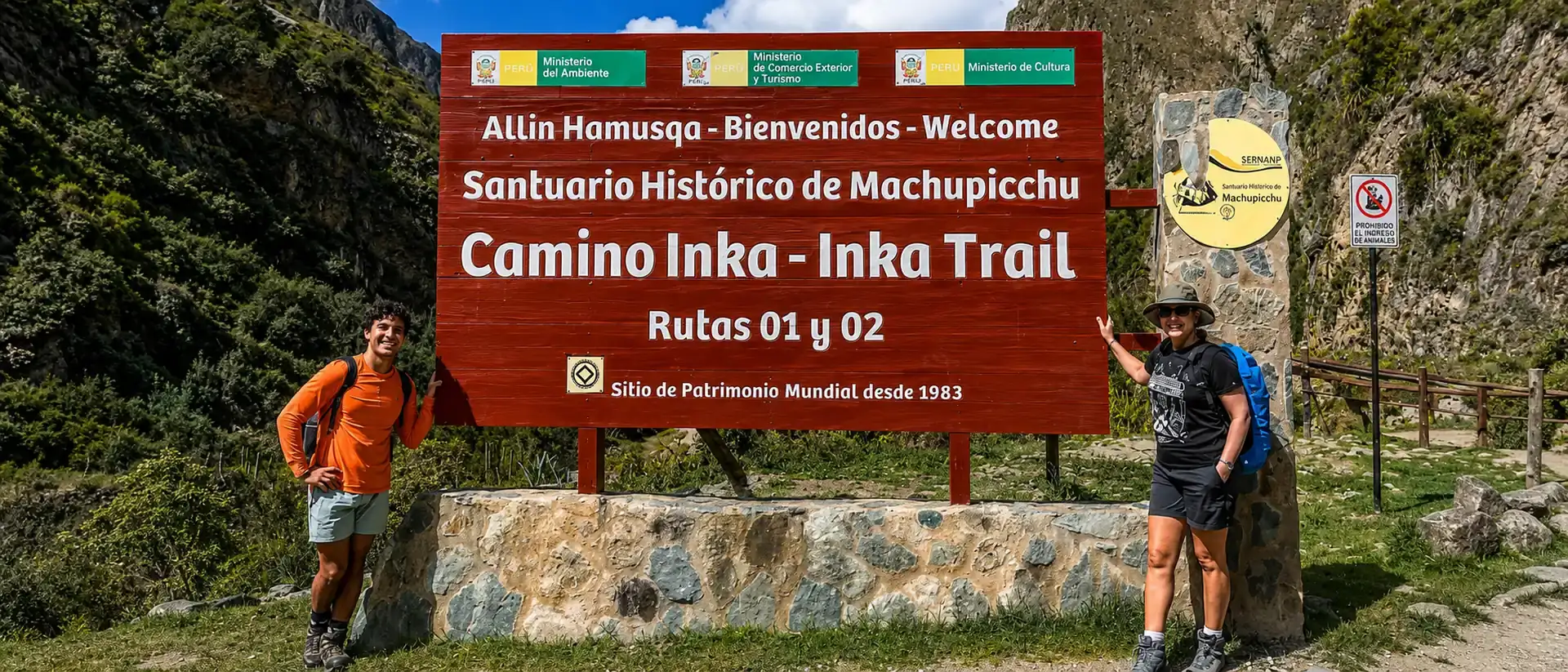
The Short Answer
The Inca Trail permit is a mandatory, government issued authorization that you can only buy through a licensed operator. Solo hiking is illegal, and there are no exceptions. Peru releases just 500 permits per day for the classic 4 day trail (only about 200 go to travelers, the rest to guides, porters, and cooks) and 250 per day for the short 2 day trail.
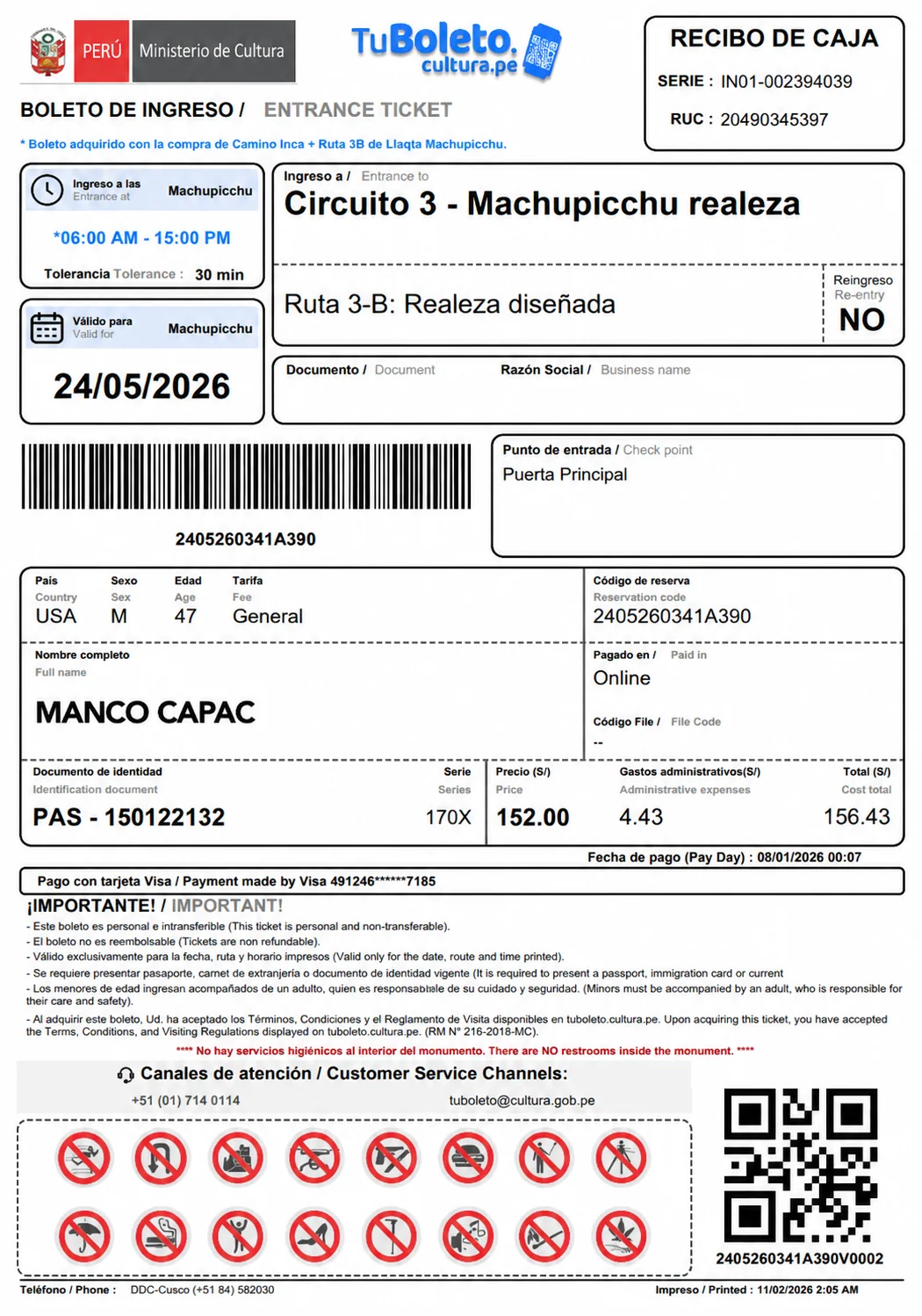
Permits for the whole year open every November and the most popular dates sell out in minutes, so you should book roughly six months ahead. For 2026 your permit also carries your Machu Picchu entrance: it includes Circuit 1-B (the classic postcard terrace), and you add the Circuit 3-B ticket for the lower royal sector, giving you two different views of the citadel.
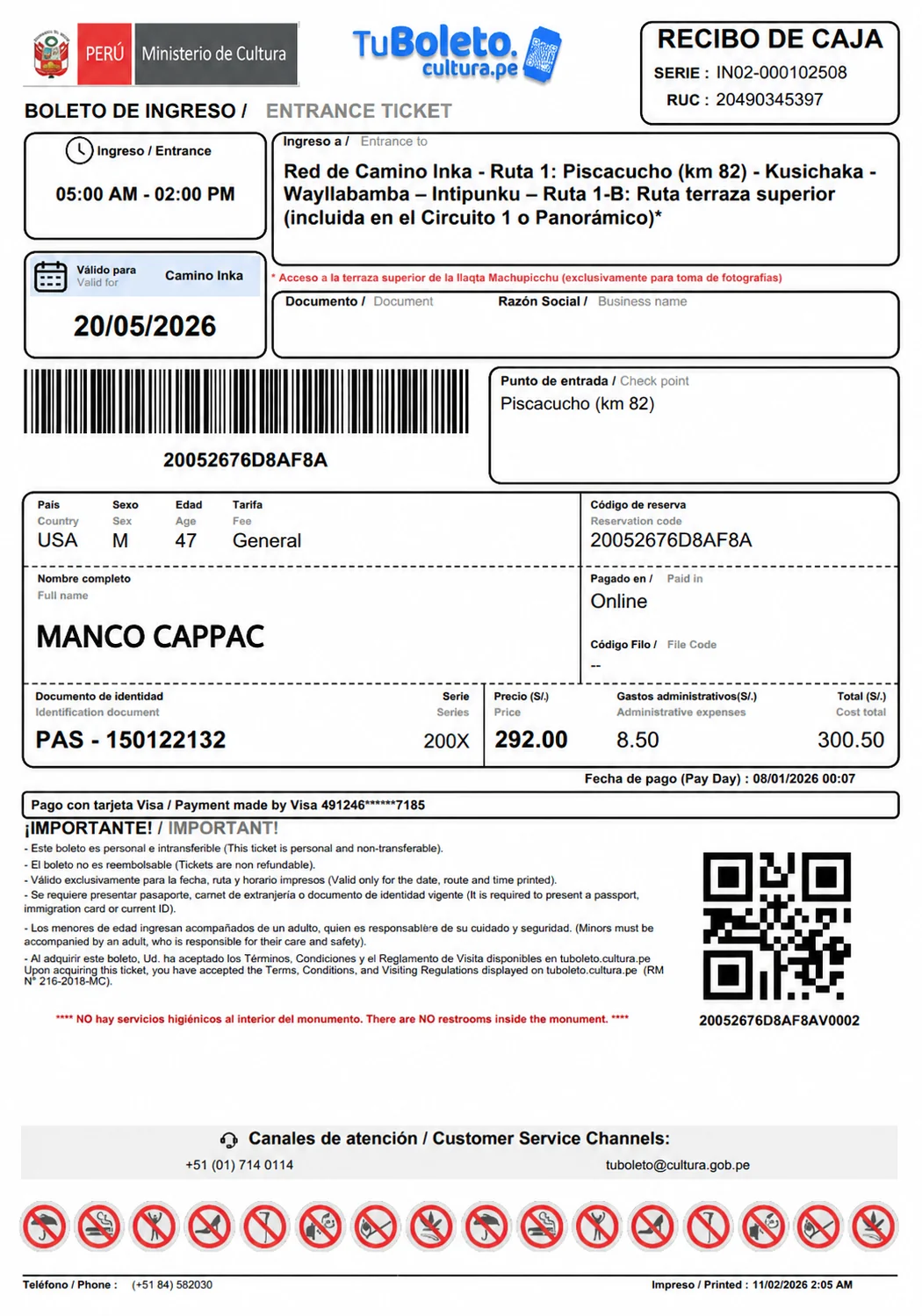
The 2026 cost is S/444 (about US$129) for the 4 day trail (S/292 permit plus S/152 Machu Picchu ticket) and S/374 (about US$108) for the 2 day trail, paid per person on top of your tour price.
What Is the Inca Trail Permit?
The Inca Trail, officially the Red de Caminos Inka, runs inside the Machu Picchu Historic Sanctuary, a protected area co regulated by two Peruvian authorities: SERNANP (under the Ministry of Environment) and the Ministry of Culture through the Direccion Desconcentrada de Cultura de Cusco (DDC Cusco). The Ministry of Culture issues and sells the permits and runs the official reservation platform, tuboleto.cultura.pe.
The permit is a personal, name and passport locked ticket. It has been mandatory since the early 2000s, when unregulated crowds of more than a thousand hikers a day were damaging the route. Since then, the rules are simple and strict:
- You cannot hike the Inca Trail independently. Every trekker must go with a licensed operator and a registered guide.
- The permit is bought in your full legal name and passport number, and it is non transferable and non refundable.
- Only Ministry of Culture and SERNANP licensed agencies can purchase permits and file the group manifest.
This is why choosing an authorized operator matters so much. At Andean Moments we hold the operating license required to secure your permit, which is the first thing that has to happen before anything else about your trek is confirmed. You can see our full lineup on our Inca Trail from Cusco page.
How Many Inca Trail Permits Are There Each Day?
The daily quotas are fixed by regulation and they are the single reason the trail sells out so far in advance.
| Route | Total permits per day | For travelers | For support staff |
|---|---|---|---|
| Classic 4 day trail | 500 | about 200 | about 300 (guides, porters, cooks) |
| Short 2 day trail (KM 104) | 250 | Most of the 250 | Few, no porters used |
Swipe the table sideways to see more →
The number that surprises most travelers is that the famous “500 permits a day” is not 500 hiking spots. The regulation caps the total at 500 including your entire crew, so in practice only around 200 travelers can start the classic route on any given day. On the short 2 day trail there are 250 permits, and because that route does not use porters, nearly all of them go to actual hikers.
For 2026 the authorities also opened a new secondary route (Ruta 6) with a much tighter cap of 100 people per day, intended to relieve pressure on the main routes. It does not change the classic 500 or the KM 104 250 figures.
When Do Inca Trail Permits Go on Sale?
Permits for an entire year are released together, and it happens the previous November. For the 2026 season, the Ministry of Culture opened reservations in a staggered schedule between November 17 and 25, 2025, one visit month at a time, all at 8:00 a.m. Cusco time. Because only licensed operators can access the booking system, your authorized agency, not you, reserves your spot on tuboleto.cultura.pe and then pays the full amount by a published deadline in the following weeks.
How fast they disappear depends on the month, and this is where real booking experience matters more than any generic calendar. Drawing on our own years of securing Inca Trail permits for travelers, here are the months ranked by demand, along with the specific dates that sell out first. May is the single most in demand month of the entire year, ahead of even June and July.
| Demand rank | Month | Fastest selling dates |
|---|---|---|
| 1 (highest) | May | May 15 to 25 |
| 2 | April | April 1 to 5 |
| 3 | June | June 15 to 30 |
| 4 | March | March 23 to 30 |
| 5 | July | July 20 to 31 |
| 6 | August | August 1 to 5 |
| 7 | September | September 9, 10, 22, 23 |
| 8 | October | October 3, 4, 9, 10 |
| 9 | November | Irregular, no fixed pattern |
| 10 | December | December 26, 27, 28 |
January is the quietest month, so if you need last minute dates, that is where any spare permits are most likely to appear.
Two more things to plan around. First, the trail closes every February for maintenance and conservation, so there are no permits that month (Machu Picchu itself stays open by train). Second, to be safe on any high season date, you should aim to book about six months ahead. That lead time is not only about grabbing a spot; as you will see below, it also affects which Machu Picchu circuits you get.
What “Sold Out” Really Means
Here is something most travelers never hear, and it can save your trip. A date that shows sold out in November does not always stay sold out.
When permits open, many agencies reserve blocks of spaces before they have travelers confirmed for them. If those reservations are not paid by the payment deadline, the unpaid spaces are released back into the system. So a date in, say, May that looked fully booked in November can quietly reopen in December once the unpaid blocks lapse. If an agency tells you a date is gone the day permits open, it is worth asking again after the payment deadline.
The important exception: a permit that was actually paid and then cancelled does not come back. Those spaces are lost for good and no one else can use them, because the ticket is non refundable and non transferable. So the spaces that reopen are the unpaid holds, not genuine paid cancellations.
How Much Does the Inca Trail Permit Cost in 2026?
Your government tickets come in two parts: the Inca Trail permit itself, which already includes your first Machu Picchu view (Circuit 1-B), and a separate Machu Picchu ticket for the lower royal sector (Circuit 3-B). These are official per person prices for 2026, and they are charged on top of your tour package.
| Route | Inca Trail permit (includes Circuit 1-B) | Machu Picchu Circuit 3-B ticket | Total per person |
|---|---|---|---|
| Classic 4 day trail | S/292 (about US$85) | S/152 (about US$44) | S/444 (about US$129) |
| Short 2 day trail | S/222 (about US$64) | S/152 (about US$44) | S/374 (about US$108) |
Swipe the table sideways to see more →
A small administrative fee applies on each official receipt as well, and the dollar figures here use an exchange rate of about S/3.45 to US$1, the rough average of recent months. Reduced rates exist for students under 25 with a valid university card and for minors, so bring the right documents if that is you. Everything else, guides, porters, meals, camping gear, and transport, is part of your tour price, not the permit.
Your Permit and Machu Picchu: The Circuit System Explained
Since Machu Picchu moved to a circuit system, this is the part that confuses travelers the most, so here it is in plain terms. The citadel is divided into three circuits, each with lettered routes:
- Circuit 1 (Panoramic): the upper level. Route 1-B is the high terrace with the classic postcard photo of Machu Picchu. It does not enter the lower town.
- Circuit 2 (Classic): the most complete route for first timers, covering the urban sector. This is the one most day visitors buy.
- Circuit 3 (Royalty): the lower royal sector. Route 3-B, Realeza Disenada, takes you past the Temple of the Sun, the Condor Temple, the ceremonial fountains, and the agricultural terraces.
For 2026, an Inca Trail permit gives you a 2-in-1 Machu Picchu experience: your permit includes Circuit 1-B (the postcard view you reach when you arrive through the Sun Gate), and you also buy the Circuit 3-B ticket for the lower sector. Together that is two entries and two different perspectives of the citadel.
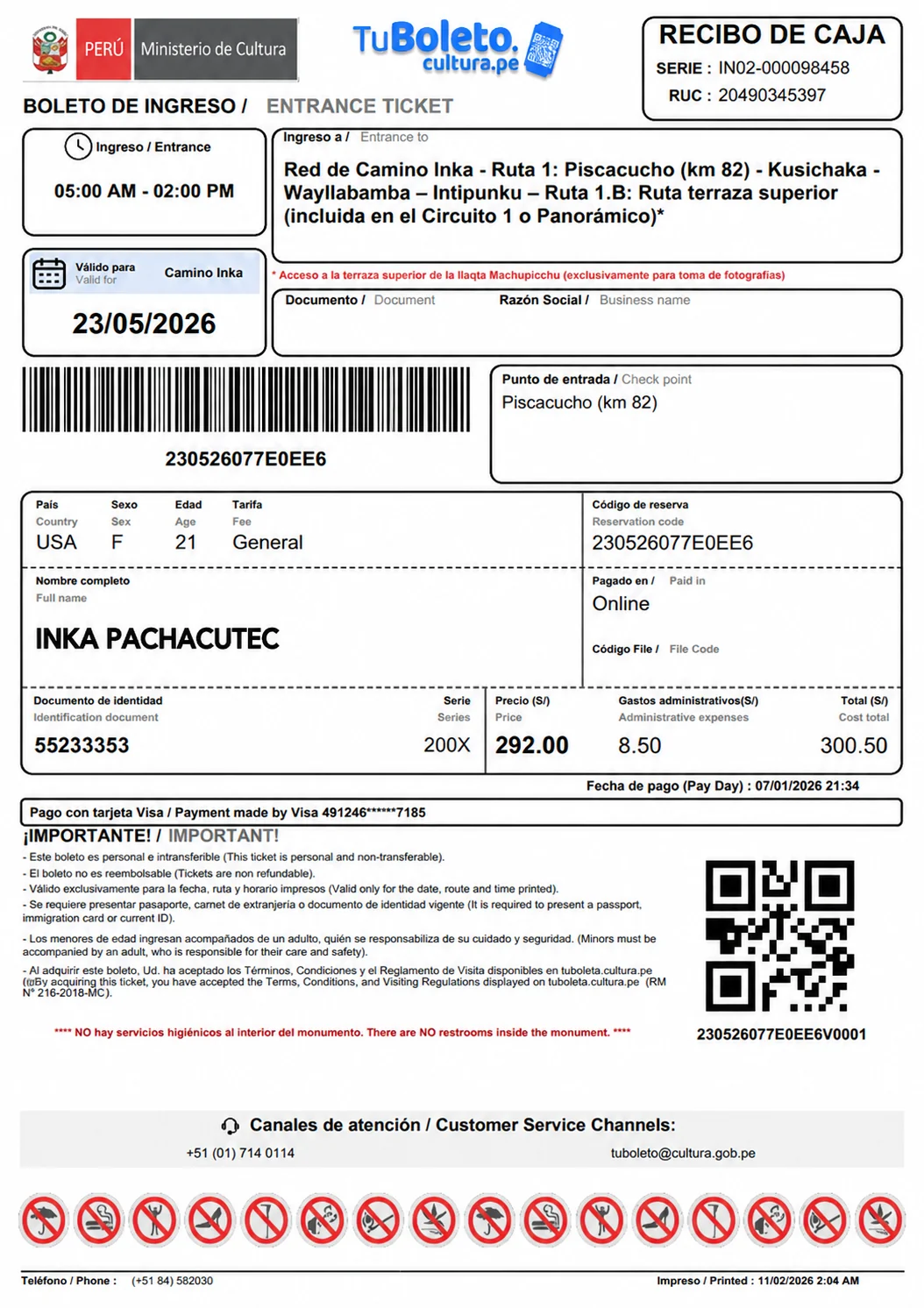
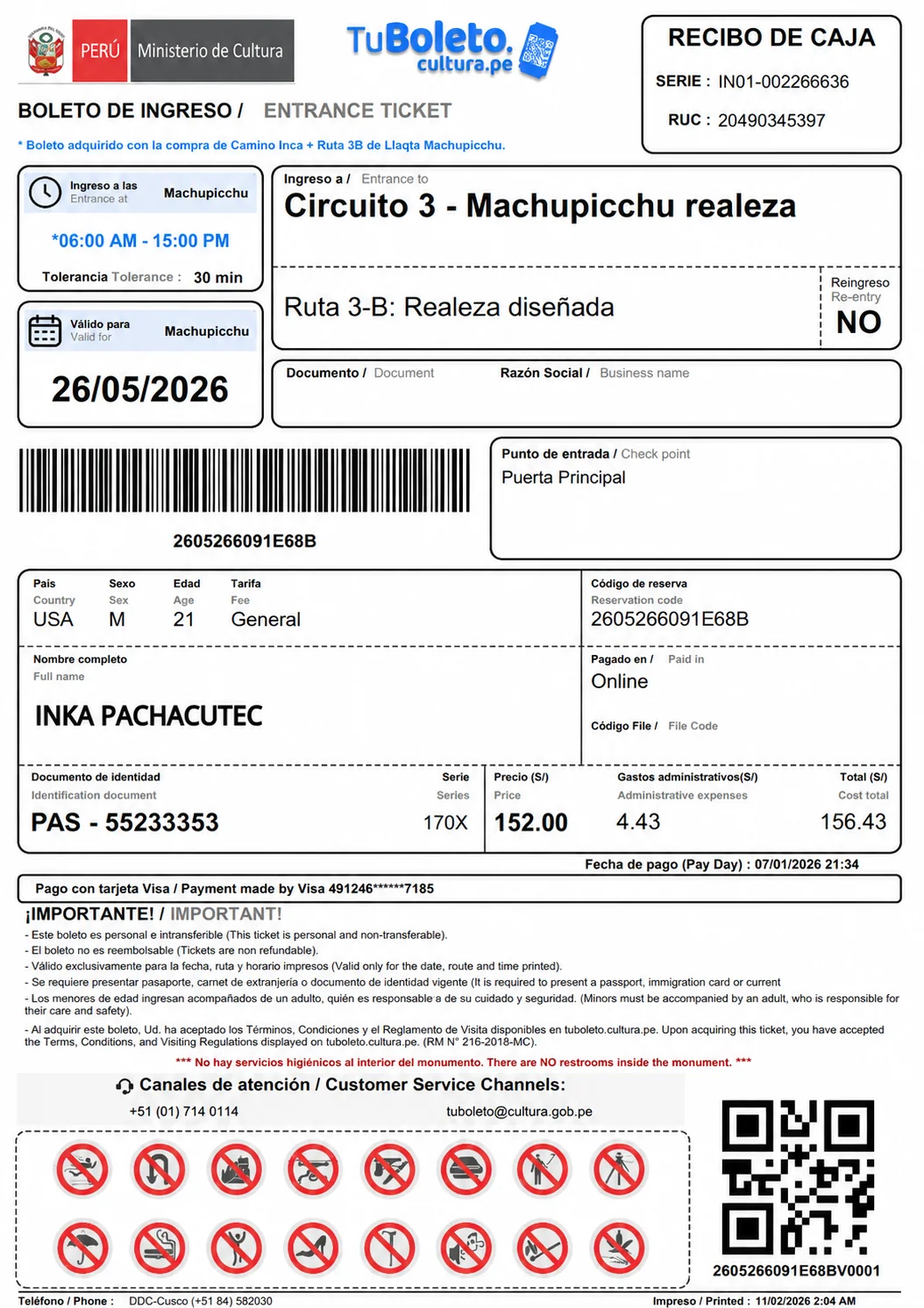
Does the permit include Circuit 2? No, and you do not need it. Circuit 2 is not part of the Inca Trail ticket. If an operator tells you Circuit 2 is included, they are quietly buying it as a third separate ticket, which would mean entering Machu Picchu three times in one day and paying more than US$45 for no real benefit. With 1-B plus 3-B you already see the classic view and the royal lower sector.
Why Your Last Campsite Matters: Winaywayna vs Phuyupatamarca
Whether you enjoy both circuits on day 4 depends on where you spend your final night, and this is a detail few travelers ask about.
- Winaywayna is the ideal last campsite. It sits close to Machu Picchu, about two hours away, so you reach the Sun Gate early on day 4 and can do both Circuit 1-B and Circuit 3-B the same day.
- Phuyupatamarca is farther out, and here the ticketing system decides for you, not your operator. When your last campsite is Phuyupatamarca, your Machu Picchu Circuit 3-B ticket is issued automatically for the fifth day, not the fourth. It is dated for day 5 and simply will not scan on day 4, so no agency can move it forward. Only Circuit 1-B is available on day 4, and to use Circuit 3-B you must spend an extra night in Aguas Calientes, which turns the trek into a 5 day trip.
Campsites are assigned by the Ministry until they fill, and Winaywayna fills first. Booking about six months ahead is the surest way to lock in Winaywayna and keep both circuits on day 4. On the short 2 day trail, the two circuits are split naturally: Circuit 1-B on day 1 when you arrive, and Circuit 3-B on day 2.
Checkpoints, Documents, and Trail Rules
Your permit is checked against your passport at several points, so a few rules are non negotiable.
- Carry your original passport every day. The name on your permit must match it exactly, middle names included. Photocopies or photos on your phone are not accepted, and a mismatch means denied entry with no appeal on the spot.
- Checkpoints: the classic route is controlled at KM 82 (Piscacucho), where your permit and bags are checked before you cross the river. The short trail starts at KM 104 (Chachabamba). There is a final control at the Sun Gate.
- Trail regulations: group sizes are capped, porter loads are limited by law, trekking poles must have rubber tips, and drones, single use plastic bottles, and camping outside authorized sites are prohibited.
If you claim a student discount, carry your valid university card as well, because it is checked at entry, not just at booking.
What to Do If the Inca Trail Is Sold Out
If your dates are gone and the payment deadline trick has not freed anything up, you still have excellent options. Several of them need no permit at all and can be booked much closer to your travel date.
- Short 2 day Inca Trail: the same iconic route into Machu Picchu through the Sun Gate, compressed into two days. It has its own 250 per day quota and usually opens up more easily than the classic. See our Inca Trail 2 Days tour.
- Salkantay Trek: a spectacular high mountain route to Machu Picchu that needs no Inca Trail permit. Explore the Salkantay Trek 4 Days.
- Choquequirao Trek: for travelers who want ruins with almost no crowds, on our Choquequirao Trek 4 Days.
If your heart is set on the classic route, the answer is simple: book the Inca Trail 4 Days as early as you can, ideally six months out.
Frequently Asked Questions
Do I need a permit to hike the Inca Trail?
Yes. The permit is mandatory and can only be bought through a licensed operator. Independent hiking has been banned since the early 2000s.
How many Inca Trail permits are released each day?
500 per day for the classic 4 day trail, including guides and porters, which leaves about 200 for travelers. The short 2 day trail has 250 per day.
How far in advance should I book?
About six months ahead for high season. May is the busiest month of all, followed by April and June, and the most in demand dates can sell out within days of release. Booking early also helps you secure the Winaywayna campsite and both Machu Picchu circuits on day 4.
Does the Inca Trail permit include Machu Picchu?
Yes for 2026. The permit includes Circuit 1-B, and you also buy the Circuit 3-B ticket, so you get two views of the citadel. Circuit 2 is not included and is not needed.
How much does the Inca Trail permit cost in 2026?
S/444 (about US$129) per person for the 4 day trail (S/292 permit plus S/152 Machu Picchu ticket) and S/374 (about US$108) for the 2 day trail, plus a small administrative fee.
Is the permit refundable or transferable?
No. It is locked to your name and passport, and it cannot be refunded or passed to another person.
Can a sold out date open up again?
Sometimes. Unpaid reservation blocks are released back into the system after the payment deadline, so a date that looked full in November can reopen weeks later. Paid permits that get cancelled do not return.
Is the Inca Trail open in February?
No. The trail closes every February for maintenance. Machu Picchu itself stays open and can be reached by train.